Best Abrasive Media for Automotive Restoration & Paint Removal
Which blast media is right for your restoration project? This guide matches the correct media type, grit size, and operating pressure to every common automotive task — from stripping multi-coat paint off body panels to deburring cast engine parts, peening springs, and achieving show-car finishes on alloy wheels.
🔍 Quick Reference — Best Media by Automotive Task
Why Media Selection Is the Single Most Important Decision
The single most damaging mistake in automotive blasting is using the wrong media for the substrate. An enthusiast who reaches for a bag of coarse aluminum oxide and blasts a thin sheet-metal door skin at high pressure will warp the panel, thin it irreversibly, and potentially create a write-off. The same operator blasting a cast iron block with walnut shell will spend hours achieving nothing, because the media is too soft to clean the heavy carbon and rust deposits.
Automotive restoration involves a wider range of materials, surface conditions, and finish requirements than virtually any other blasting application — thin pressed steel, cast iron, cast aluminium, aluminium alloy forgings, stainless steel trim, chrome plate, CFRP body panels on modern vehicles, rubber seals, and glass, sometimes all within a few inches of each other on the same component. No single media or pressure setting serves all of these materials. This guide maps the correct media to each common task.
❌ Wrong Media — Common Failures
- Coarse Al₂O₃ on thin door skin → panel warped and thinned
- Angular media on alloy wheel → rough surface, finish destroyed
- Steel grit on aluminium block → iron contamination, corrosion sites
- High pressure plastic media on CFRP → fibre exposure, structural damage
- Walnut shell on heavy rust → hours wasted, no substrate reached
- Glass beads on chassis scale → peened rust in place, not removed
✓ Correct Media — What to Expect
- Plastic media 20–30 mesh on door skin → bare metal, panel undamaged
- Glass beads 80–120 on alloy wheel → uniform satin finish
- Aluminum oxide 60–80 on aluminium block → clean, no iron
- Melamine 30 mesh, 45 psi on CFRP → paint stripped, fibres intact
- Al₂O₃ 36 mesh on chassis → near-white metal in one pass
- Al₂O₃ 60–80 on body panels → surface profile for primer adhesion
Media by Job Type — Six Key Automotive Tasks
Body panel rust removal is the most common automotive blasting task and the one most often done incorrectly. The substrate is thin-gauge pressed steel that will warp or thin under excessive blast pressure or too coarse a media. The goal is to reach bare metal without leaving panel damage that requires filler before primer.
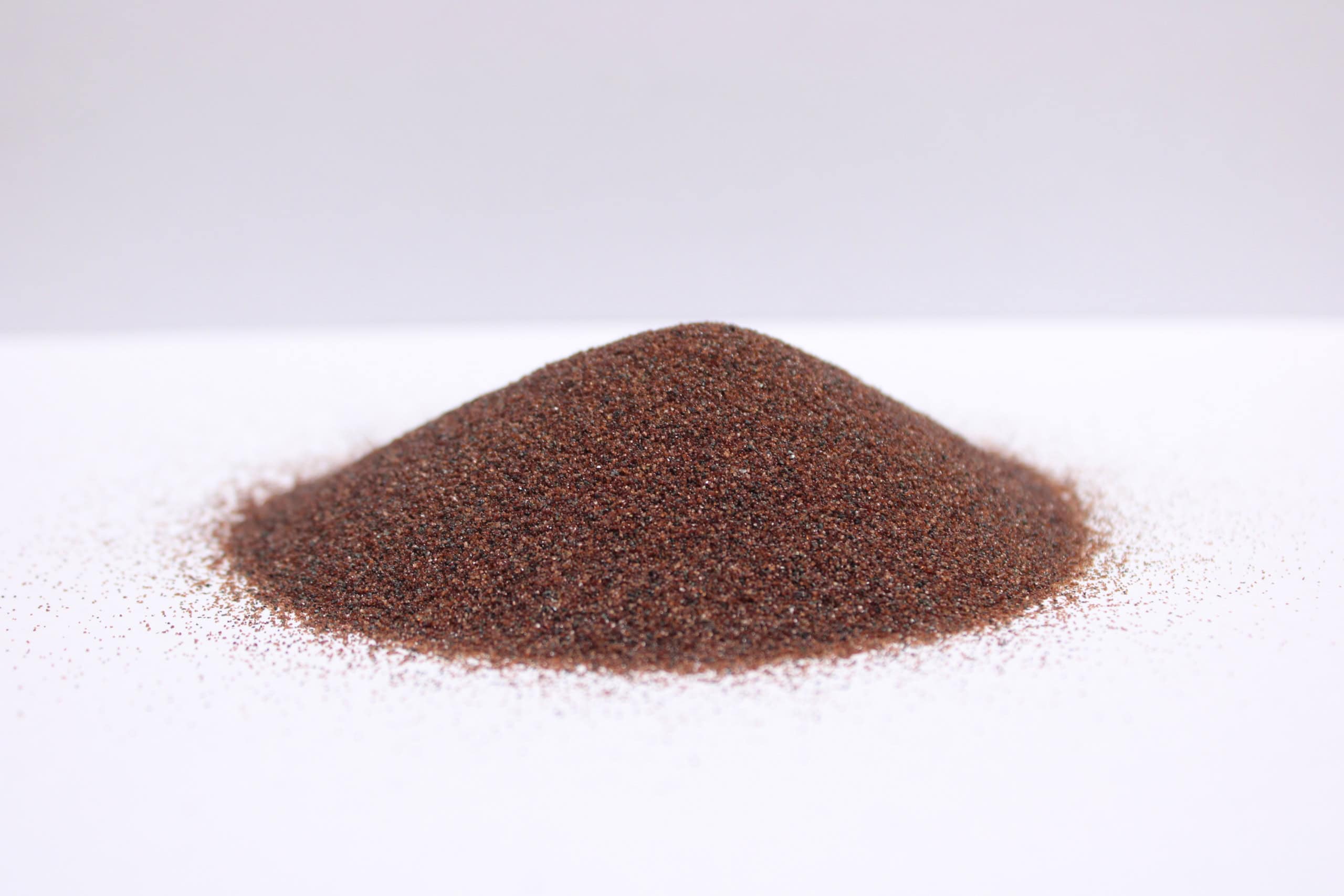
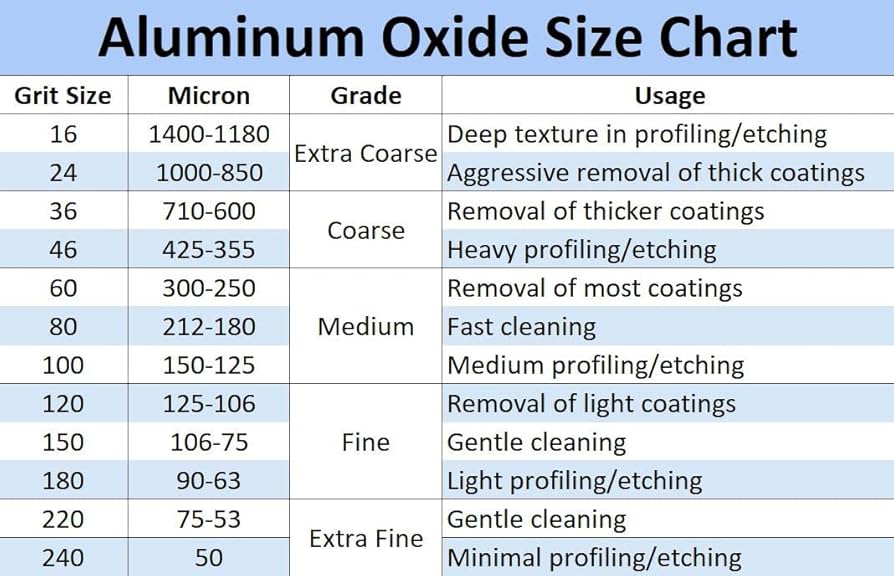
The correct approach is medium-grit aluminum oxide or garnet at moderate pressure with a wide fan nozzle, maintaining 12–18 inches of standoff distance and keeping the nozzle moving continuously. Never dwell on a single spot.
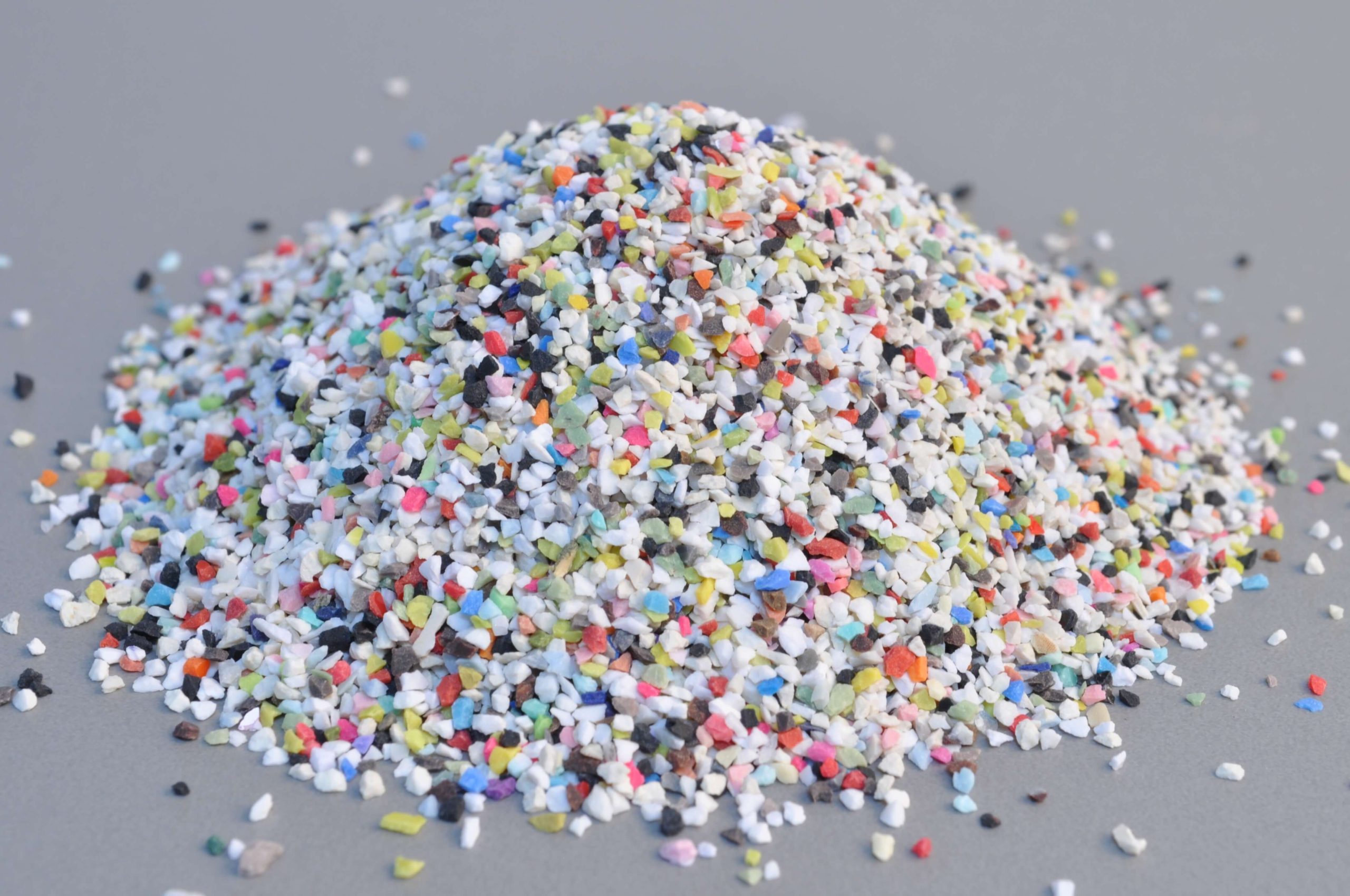
Stripping decades of repaints from a classic vehicle body requires removing 4–8 layers of paint, filler, and primer without distorting the original panel geometry or creating telegraphing marks that show through the new paint. This is the application that plastic blast media was developed to address.
Plastic media at 20–30 mesh removes the complete paint stack in 2–3 passes, leaving the bare metal surface in its original dimensional condition. Follow with a light pass of aluminum oxide 80 mesh at 55 psi to create the surface profile for primer adhesion.
Chassis rails, crossmembers, and subframes are substantially heavier gauge than body panels and carry scale, thick rust, and old undercoating or sound deadener. This substrate tolerates and benefits from more aggressive media and higher pressure than bodywork, with the goal of achieving a clean anchor profile for the etch primer or chassis coating.
Aluminum oxide 36–46 mesh or garnet 30–36 mesh at 70–85 psi delivers SSPC-SP10 Near-White cleanliness with a 1.5–2.0 mil profile that chassis coating systems specify. For very heavy rust or scale, start with 24–36 mesh.
Engine components present two distinct cleaning challenges in one assembly: external cleaning of carbon, oil, rust, and old paint from cast surfaces; and precise cleaning of machined mating surfaces, bores, and threaded inserts where dimensional control is critical. The two tasks require different media.
For external cast surfaces: aluminum oxide 60–80 mesh cleans efficiently. For machined surfaces, bearing journals, and threaded areas: glass beads 80–120 mesh produces a clean, non-profiled surface without dimensional loss. Critical: mask all bores, oil galleries, and threaded holes before blasting; media contamination in oil passages is an engine-destroying error.
Competitive show car preparation demands a level of surface consistency that is impossible to achieve by hand polishing alone. Glass bead blasting produces the uniform satin or bright finish on alloy wheels, stainless exhaust components, and brightwork that creates the “freshly machined” appearance judges look for — consistent across every surface, without the swirl marks and high spots that hand work leaves.
Fine glass beads (100–150 mesh) at 40–50 psi deliver a bright satin finish on aluminium alloys. For high-lustre work on polished stainless, use 150–230 mesh at 35–45 psi.
Carburettors, intake manifolds, valve covers, and other small aluminium castings accumulate decades of baked carbon, gasket adhesive, oil, and oxidation. These components have thin walls, delicate passages, and precise dimensions that cannot tolerate aggressive media or high pressure. The goal is cleaning without dimensional change.
Walnut shell or corn cob at 12–20 mesh and 40–55 psi cleans these components effectively — the media is hard enough to remove carbon and oxidation but too soft to abrade or scratch the base aluminium. Glass beads 80–120 mesh works for the final cleaning pass on machined mating faces.
Body Panel Preparation in Depth
Body panels deserve expanded coverage because they are the highest-stakes substrate in automotive restoration work — both in terms of cost to replace if damaged and in terms of the effect incorrect preparation has on the final paint quality. A warped panel, a thinned section, or a surface covered in deep blast marks will telegraph through even the best paint application.
The Warping Risk — Why It Happens and How to Avoid It
Sheet metal panels warp under blast impact when the thermal and mechanical stresses induced by abrasive impact exceed the material’s ability to elastically recover. This risk increases with: higher blast pressure; coarser media; harder media; shorter standoff distance; slower nozzle movement; and thinner gauge steel. The risk is highest on flat, unsupported panel sections (door skins, roofs, bonnets) and lowest on curved, structurally ribbed sections (wheel arches, sills).
- Use the finest grit that completes the job: 80 mesh aluminum oxide will remove surface rust from a door skin without warping; 36 mesh will likely warp it.
- Keep the nozzle moving: Never dwell on a single point. Use overlapping circular or figure-8 patterns.
- Maintain standoff: 12–18 inches minimum on body panels. Moving closer dramatically increases impact energy.
- Use a fan nozzle: Spreads the impact over a wider area, reducing localised stress.
- Consider plastic media for complete bare-metal work: On panels with multiple paint layers or original filler, plastic media eliminates the warping risk entirely while still achieving bare metal.
Surface Profile Requirements for Automotive Paint Systems
Automotive refinishing primers vary in their surface profile requirements, but the general principle is: finer profile for lighter build coatings, more texture for high-build or chip-resistant systems.
| Coating System | Profile Required | Recommended Media | Notes |
|---|---|---|---|
| Epoxy primer (standard) | 0.5 – 1.0 mil | Al₂O₃ 80 mesh or glass beads 80–120 | Most common automotive restoration primer; good adhesion to clean metal |
| Etch primer (self-etching) | 0.3 – 0.5 mil (or bare clean metal) | Glass beads 80–120 mesh or plastic media | Relies on chemical adhesion; excessive profile reduces bond strength |
| High-build urethane primer | 0.5 – 1.2 mil | Al₂O₃ 60–80 mesh | Body filler and high-build primer require slightly more profile for adhesion |
| Powder coat (chassis / wheels) | 1.0 – 2.0 mil | Al₂O₃ 46–60 mesh or garnet 36–60 | Powder coat requires more surface anchor than liquid paint for adhesion |
| POR-15 / chassis coating | 1.5 – 2.5 mil | Al₂O₃ 36–46 mesh or garnet 30–36 | High-build rust encapsulator requires substantial anchor profile |
| Anodising (aluminium) | Clean bare metal — no profile | Glass beads 80–120 mesh or WFA Al₂O₃ 100+ | Anodise is a surface conversion process; requires clean, degreased bare Al |
Chassis, Frame & Structural Steel
Chassis components are the workhorse of the restoration — heavy gauge steel that has often spent decades exposed to road salt, moisture, and abrasion. The blasting goal here is not cosmetic but functional: achieve a clean, profiled surface that provides maximum adhesion for the rust prevention coating system that will protect the vehicle for the next generation of ownership.
For complete chassis preparation, the recommended process is a two-step sequence: a first pass with aluminum oxide 36–46 mesh or garnet 30–36 at 75–85 psi to remove all rust scale, old undercoating, and surface contamination; followed by a second pass with the same media at 65–75 psi to achieve a consistent surface profile across all surfaces before coating application. For particularly pitted or heavily corroded sections, fill pits after blasting and before priming using compatible filler compounds as specified by the coating manufacturer.
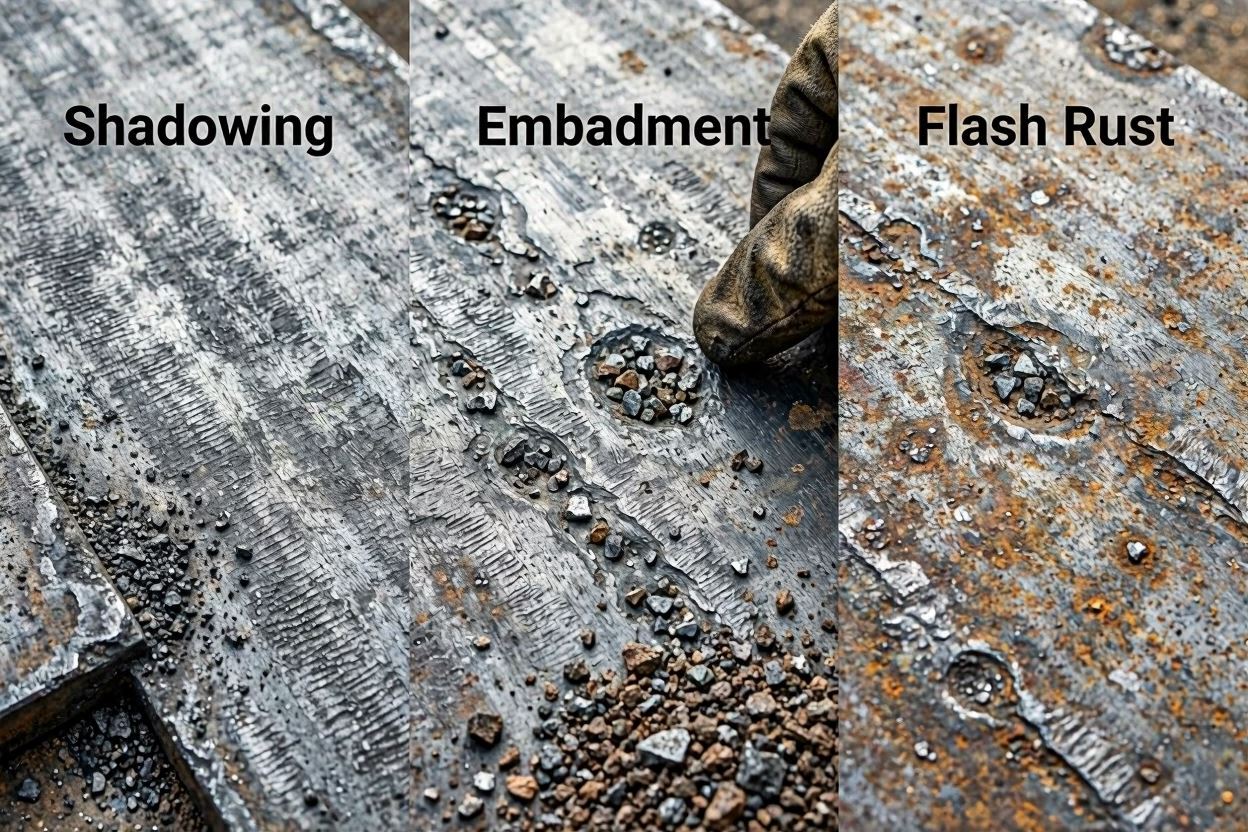
Freshly blasted bare steel oxidises extremely rapidly, particularly in humid conditions. Surface rust (flash rust) can begin forming within 30 minutes of blasting in high-humidity environments, and within 2–4 hours under normal workshop conditions. Apply the first coat of primer or rust inhibitor as soon as practicable after blasting — the same day is the standard requirement. Do not blast a chassis section in the morning and leave it overnight before priming.
Engine & Drivetrain Components
Engine components present the most complex media selection challenge in automotive restoration because a single assembly combines cast iron (block and heads), hardened steel (cam, crank journals), soft aluminium alloy (intake manifold, timing cover), and precision-machined surfaces (mating faces, valve seats, bearing bores) that must all be cleaned without contamination of oil galleries or dimensional alteration of machined fits.
The Critical Rule: Mask Everything Before Blasting
Blast media contamination inside oil passages, coolant galleries, cylinder bores, and bearing housings is one of the most serious and expensive mistakes in engine rebuilding. A single blast particle in an oil gallery can cause catastrophic bearing failure within minutes of first engine start. Before blasting any engine component, every opening must be plugged or taped: all threaded holes (oil drain plugs, sensor bungs), all coolant and oil galleries (rubber expansion plugs), all cylinder bores (foam bung or rag), and all bearing housing bores (tape or machined plugs).
After blasting, use compressed air blow-down followed by a thorough wash-out with clean solvent through all galleries and passages before assembly. Confirm media contamination is zero before assembly by blowing through all passages and inspecting blow-out cloths for media particles.
Finishing, Peening & Show Work
Alloy Wheel Restoration
Alloy wheels for daily drivers and competition vehicles need a consistent, clean surface free of previous paint and oxidation before refinishing. Glass beads at 80–120 mesh produce the standard satin-aluminium finish most wheel refinishers specify before applying basecoat or clear. For bare polished wheels, step up to 100–150 mesh for a brighter result. Avoid aluminum oxide on alloy wheels — the angular particles create micro-scratches that show under clear coat unless the surface is subsequently polished.
Spring and Fastener Peening
Coil springs, valve springs, torsion bars, and high-stress fasteners in competition vehicles benefit enormously from shot peening using glass beads at 100–150 mesh. The compressive residual stress layer introduced by controlled glass bead peening extends fatigue life by 50–150% in controlled testing on spring steel — a measurable performance and reliability improvement for track-day or racing applications. For springs, the peening specification should call out Almen intensity to a defined arc height (typically 4A–10A on A-strip) and 98% coverage to ensure uniformity.
Walnut Shell and Corn Cob for Delicate Assemblies
Carburettors, distributor housings, alternator and starter motor housings, and other precision die-cast aluminium assemblies can be cleaned of carbon, oil film, and light oxidation using walnut shell at 12–20 mesh in a suction blast cabinet. The media is hard enough to dislodge carbon but soft enough (Mohs ~3.5) not to abrade or scratch the cast aluminium surface. This makes it ideal for the preparation of show-car engine bay components where visual perfection and dimensional integrity must coexist. See our eco-friendly abrasive media guide for full coverage of organic blast media options.
Pressure & Equipment Settings by Component
Side-by-Side Media Comparison for Automotive Use
| Media | Body Panels (thin steel) | Chassis / Frame (heavy steel) | Aluminium Engine Parts | Alloy Wheels / Trim | Paint Stripping | Show / Satin Finish |
|---|---|---|---|---|---|---|
| Al₂O₃ (BFA) 60–80 | ⚠ Use care | ✓ Excellent | ✓ Good | ✗ Scratches clear coat | ⚠ Profiles substrate | ✗ |
| Glass Beads 80–120 | ✓ Safe on thin panels | ✗ Too slow for heavy rust | ✓ Excellent — no iron | ✓ Excellent | ✗ No profile — use pre-coat | ✓ Satin finish |
| Garnet 36–60 | ⚠ Low dust, moderate aggression | ✓ Very good — low dust | ⚠ Trace iron risk | ✗ | ⚠ Profiles substrate | ✗ |
| Plastic Media 20–30 | ✓ Best choice — no warp | ✗ Too slow for scale | ✓ Safe on Al | ⚠ Strips paint only | ✓ Excellent | ✗ |
| Walnut Shell 12–20 | ✗ Too slow for rust | ✗ | ✓ Carbon & oil removal | ✗ | ⚠ Light coatings only | ✗ |
| Steel Grit G40–G50 | ✗ Warps thin panels | ✓ Excellent (wheel blast) | ✗ Iron contamination | ✗ | ✗ Over-aggressive | ✗ |
Five Common Automotive Blasting Mistakes
- Using coarse media on thin body panels. Al₂O₃ at 36 mesh or garnet at 30 mesh is appropriate for chassis rails but will warp door skins and thin quarter panels. Always use 60–80 mesh minimum for body panel work, and consider plastic media for any panel thinner than 1.2 mm or with large flat unsupported sections.
- Not masking engine oil galleries before blasting. A single glass bead or aluminum oxide particle trapped in an oil gallery that reaches a bearing surface after engine startup causes catastrophic bearing failure. Plug every opening — every threaded hole, every gallery port, every bore — before the first blast pass. Wash out and verify zero contamination before assembly.
- Using angular media on alloy wheels. Aluminum oxide and garnet leave angular micro-scratches on aluminium alloy surfaces that show as haze under clear coat — often only visible after the wheel is fully painted and clear-coated, at which point correction requires stripping and repainting. Use glass beads 80–120 mesh on wheels.
- Leaving bare metal overnight before priming. Flash rust begins within hours on freshly blasted steel, especially in humid workshop environments. The entire point of achieving near-white metal is to provide maximum adhesion surface for the primer — surface rust negates this entirely. Prime or apply a rust inhibitor the same day as blasting.
- Using glass beads to “clean rust” from chassis components. Glass beads are not a rust removal media — they peen and compress the surface, which can actually seal light surface rust into the substrate rather than removing it. For any rust removal work on steel, use an angular abrasive (aluminum oxide or garnet) that cuts through and removes the rust layer rather than peening it in place.
Ordering from Jiangsu Henglihong Technology
Henglihong supplies the full range of automotive blast media grades with consistent batch quality. Whether you are a solo restorer working through a single classic vehicle or an automotive restoration shop processing dozens of projects per year, our technical team can recommend the right combination of media grades for your specific vehicle types and coating systems. Contact us with your project details for a personalised recommendation and quantity guidance.
Часто задаваемые вопросы
What is the best abrasive media for stripping paint from a car body?
For stripping multiple layers of paint from a car body while preserving the panel dimensions and avoiding warping, plastic blast media (urea formaldehyde, 20–30 mesh) is the best choice. It removes all paint layers in 2–3 passes without abrading, profiling, or dimensionally altering the sheet metal. After stripping to bare metal with plastic media, apply a light pass of aluminum oxide 80 mesh at 55–60 psi to create a 0.5–0.8 mil surface profile for primer adhesion before applying epoxy primer. For panels with only surface rust (no multi-coat paint stack), aluminum oxide 60–80 mesh at moderate pressure achieves bare metal efficiently.
Will blasting warp my body panels?
Yes, if done incorrectly. The primary risk factors for panel warping are: using coarse media (36 mesh or coarser on thin body panels); excessive blast pressure (above 65 psi on panels thinner than 1.2 mm); short standoff distance (less than 10 inches); and dwelling on a single spot rather than keeping the nozzle moving. To minimise warping risk: use 60–80 mesh media, limit pressure to 50–65 psi, maintain 12–18 inch standoff, use a fan nozzle, keep the nozzle moving continuously, and consider plastic media for large flat sections like roof panels and door skins.
Can I use blasting media on aluminium engine parts?
Yes, with the right media selection. Aluminium oxide 60–80 mesh at 55–65 psi is effective for cleaning cast aluminium surfaces. For machined faces and precision surfaces, glass beads 80–120 mesh is safer — it cleans without creating a profile or removing measurable material from machined dimensions. Do not use garnet on aluminium parts where corrosion resistance is important, as garnet’s natural iron content can transfer trace iron to the surface and create corrosion initiation sites. Never use steel grit or steel shot on aluminium — iron contamination from steel abrasives will cause rapid corrosion. Most importantly, mask and plug every oil passage, bore, and threaded hole before blasting any engine component.
What media should I use for glass beading alloy wheels?
Glass beads 80–120 mesh at 40–55 psi is the standard specification for alloy wheel preparation and refinishing. The spherical glass beads produce a uniform, clean satin surface on the aluminium alloy without leaving the micro-scratches that angular abrasives (aluminum oxide, garnet) create. These micro-scratches are invisible on bare metal but show as surface haze under clear coat after painting — an expensive problem to correct. For show-car or highly polished wheel finishes, use 100–150 mesh glass beads at 40–50 psi for a brighter result.
How long can I leave bare metal before priming?
As little time as possible — ideally the same day. Freshly blasted steel begins oxidising within 30 minutes in high-humidity conditions. Under normal workshop conditions (50–60% relative humidity), visible flash rust typically appears within 2–8 hours. In dry conditions it may take longer, but the surface chemistry is still degrading. Industry standard practice is to apply the first coat of epoxy primer or rust inhibitor within 4 hours of blasting. If you cannot prime on the same day, apply a temporary rust inhibitor (thin oil or flash rust preventative wash primer) immediately after blasting and blast lightly with glass beads before priming the following day to remove any surface oxidation that has formed.
Ready to Source Blast Media for Your Restoration Project?
All automotive grades in stock — plastic media, glass beads, aluminum oxide, garnet, walnut shell. 25 kg bags through container loads. Technical recommendations included for all orders.
Request a Quote View All Abrasive Media Products →Фильтры